

Stainless Steel Sculpture Fabrication: Process, Welding, Finishing, and Large-Scale Production
Stainless steel sculpture fabrication combines artistic design, engineering, precision metalworking, welding, and advanced finishing techniques to create durable contemporary artworks.
Stainless steel is widely used in modern and large-scale sculpture because of its strength, corrosion resistance, structural versatility, and ability to achieve a wide range of surface finishes. Depending on the artistic concept, a sculpture can feature brushed, satin, polished, textured, or mirror-like surfaces.
The fabrication process can vary significantly depending on the geometry, scale, finish, and final location of the artwork. A relatively simple geometric sculpture may be produced through direct metal fabrication, while a complex large-scale piece may require digital modeling, internal structures, sectional production, precision welding, extensive surface finishing, specialized transportation, and final installation.
Since 1993, Alfa Arte has collaborated with artists, architects, and institutions on sculptural projects using stainless steel and other metals, combining artistic craftsmanship with engineering, metal fabrication, finishing, and large-scale project capabilities.
What Is Stainless Steel Sculpture Fabrication?
Stainless steel sculpture fabrication is the process of transforming an artistic concept or model into a finished stainless steel artwork using specialized metalworking and engineering techniques.
Depending on the project, this process may involve:
- artistic consultancy;
- digital modeling;
- 3D scanning;
- structural engineering;
- cutting;
- forming;
- bending;
- machining;
- welding;
- assembly;
- grinding;
- polishing;
- surface finishing;
- transportation;
- installation.
Unlike cast sculpture, many stainless steel artworks are fabricated directly from sheets, plates, tubes, profiles, or custom-formed components.
This makes the material particularly suitable for contemporary works that rely on geometry, precision, structural clarity, and controlled surfaces.
Why Is Stainless Steel Used in Sculpture?
Stainless steel offers a combination of structural and aesthetic properties that make it particularly attractive for contemporary sculpture.
Its main advantages include:
- corrosion resistance;
- high mechanical strength;
- long-term durability;
- suitability for outdoor use;
- structural versatility;
- multiple finishing options;
- contemporary appearance;
- ability to create reflective surfaces.
It can be used for small interior artworks as well as monumental installations several meters high.
The material also interacts strongly with light and surrounding architecture, especially when highly polished finishes are used.
How Is a Stainless Steel Sculpture Fabricated?
The process depends on the artwork, but generally includes several stages:
- Analysis of the artistic concept.
- Digital modeling and technical development.
- Structural engineering.
- Selection of stainless steel grade and thickness.
- Division into fabrication sections.
- Cutting.
- Forming and bending.
- Internal structure fabrication.
- Welding and assembly.
- Grinding and surface reconstruction.
- Polishing or finishing.
- Quality control.
- Transportation.
- Installation.
These stages form part of the broader sculpture fabrication process, but stainless steel introduces specific technical requirements related to welding quality, dimensional precision, and surface finishing.
1. Artistic Concept and Technical Development
Every stainless steel sculpture begins with an artistic idea.
The starting point may include:
- sketches;
- drawings;
- physical maquettes;
- digital models;
- 3D files;
- architectural plans;
- an existing sculpture.
Before fabrication begins, the design must be evaluated from both an artistic and technical perspective.
Important questions include:
- What dimensions will the finished artwork have?
- Which surfaces need to be reflective or textured?
- Will the sculpture be installed indoors or outdoors?
- What structural loads must it withstand?
- How can it be divided for fabrication and transport?
- How will it be anchored at the final location?
Alfa Arte’s artistic consultancy helps assess artistic, technical, and production requirements during the early stages of a project.
2. Digital Modeling and 3D Development
Digital modeling is particularly useful in stainless steel sculpture fabrication because the material often requires highly precise geometry.
A digital model can be used to:
- define final dimensions;
- develop complex surfaces;
- calculate individual components;
- plan joints;
- design internal structures;
- prepare cutting files;
- analyze assembly sequences.
For existing physical models, 3D scanning can be used to capture the original artwork and convert it into digital geometry.
Alfa Arte’s digital modeling and 3D scanning capabilities allow artistic models to be translated into precise digital information for fabrication.
3. Engineering for Stainless Steel Sculptures
Engineering becomes especially important in large-scale stainless steel artworks.
The visible surface of the sculpture may appear light or minimal, while internally it can require a complex structure capable of handling substantial loads.
Depending on the project, engineering analysis may consider:
- total weight;
- center of gravity;
- wind loads;
- structural loads;
- material thickness;
- internal reinforcement;
- connection systems;
- foundations;
- anchoring points;
- lifting points.
For permanent outdoor sculptures, engineers must also consider long-term environmental exposure and the structural behavior of the artwork over time.
4. Selecting the Stainless Steel
Not all stainless steel is identical.
The appropriate grade, thickness, and format depend on factors such as:
- environment;
- sculpture dimensions;
- structural requirements;
- desired surface finish;
- fabrication method;
- maintenance expectations.
For projects in demanding environments, material selection becomes particularly important.
The correct specification helps ensure long-term durability while achieving the intended visual result.
5. Dividing the Sculpture Into Sections
Large stainless steel sculptures are rarely fabricated as a single piece.
They are normally divided into sections according to:
- available equipment;
- plate dimensions;
- forming requirements;
- welding access;
- transportation limits;
- crane capacity;
- installation strategy.
This division must be planned carefully.
Poorly positioned joints can create both structural and aesthetic problems.
Ideally, the sectional strategy is developed during the digital modeling and engineering stages.
6. Cutting Stainless Steel Components
Once the geometry has been defined, individual components can be cut from stainless steel sheets or plates.
Depending on the project, methods may include:
- laser cutting;
- waterjet cutting;
- plasma cutting;
- mechanical cutting;
- CNC machining.
Precision during this phase is fundamental because even small dimensional errors can become significant when multiple components are assembled into a large artwork.
7. Forming and Bending
After cutting, flat metal components may need to be transformed into three-dimensional forms.
Processes can include:
- rolling;
- bending;
- press forming;
- manual forming;
- custom tooling.
Complex curved sculptures may require numerous individually formed panels.
Each panel must align accurately with neighboring components to maintain the intended geometry.
For organic or highly complex surfaces, digital models can guide the forming process.
8. Fabricating the Internal Structure
Many large stainless steel sculptures require an internal structural framework.
The outer skin defines the visible artistic form, while the internal system provides stability and strength.
Internal structures may use:
- stainless steel profiles;
- steel profiles;
- welded frameworks;
- custom structural components;
- reinforced connection systems.
The structure must be designed so that it does not deform the exterior surface.
Alfa Arte’s metalworking and technical structures service allows complex structural systems to be integrated into large-scale artistic projects.
9. Welding Stainless Steel Sculpture Sections
Welding is one of the most critical stages of stainless steel sculpture fabrication.
Poor welding can affect:
- geometry;
- structural integrity;
- surface quality;
- corrosion resistance;
- final appearance.
Depending on the project, different welding techniques may be used.
The objective is to achieve strong, precise connections while minimizing deformation.
Heat generated during welding can distort thin stainless steel surfaces, so the assembly sequence and welding strategy must be carefully controlled.
10. Grinding and Surface Reconstruction
After welding, the joints normally need to be finished until they visually disappear.
This can involve:
- grinding;
- leveling;
- sanding;
- surface blending;
- texture reconstruction.
The difficulty of this process depends on the final finish.
A welded joint on a textured surface may be easier to integrate than one on a highly polished mirror-finish sculpture.
For reflective artworks, surface continuity must be extremely precise.
11. Stainless Steel Sculpture Finishes
Surface finishing is one of the most distinctive aspects of stainless steel sculpture.
Different treatments can create completely different visual results.
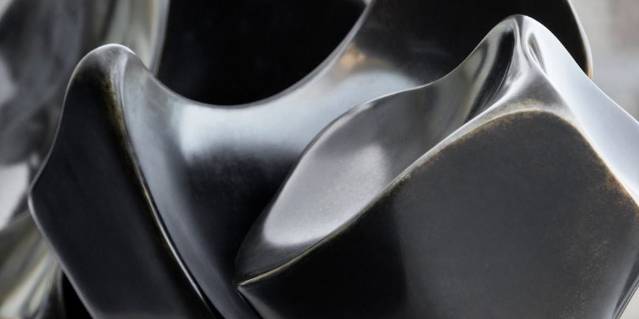
Mirror-Polished Stainless Steel Sculpture
A mirror finish creates a highly reflective surface that interacts with:
- architecture;
- sky;
- landscape;
- visitors;
- changing light.
Producing a high-quality mirror finish requires multiple stages of grinding and polishing.
Any imperfections, weld marks, or surface distortions can become highly visible.
For this reason, mirror-polished artworks demand exceptional precision during fabrication.
Satin-Finished Stainless Steel Sculpture
A satin finish provides a softer and more controlled appearance.
It reduces reflections while preserving the metallic character of the material.
This type of finish is often used for:
- contemporary outdoor works;
- architectural sculptures;
- public art;
- geometric pieces.
Brushed Stainless Steel Sculpture
Brushed finishes create a visible directional grain across the metal.
Consistency is essential because variations in brushing direction can be noticeable across large surfaces.
Textured Stainless Steel
Artists may also use different mechanical or manual techniques to create textured surfaces.
These can generate more complex interactions with light while reducing the visual precision required for highly reflective finishes.
Alfa Arte’s patina, painting and finishes capabilities support specialized surface treatments according to the artistic requirements of each project.
12. Quality Control
Quality control is essential before the artwork leaves the workshop.
Checks may include:
- dimensions;
- geometry;
- weld quality;
- structural connections;
- surface continuity;
- polishing consistency;
- anchoring systems;
- conformity with the approved design.
Reflective sculptures require particularly detailed visual inspections because surface imperfections can become visible under changing lighting conditions.
Large-Scale Stainless Steel Sculpture Fabrication
As the dimensions of a stainless steel sculpture increase, the technical challenges become more significant.
A large-scale project may require:
- structural engineering;
- internal frameworks;
- modular fabrication;
- precision welding;
- large surface finishing;
- specialized lifting;
- oversized transportation;
- on-site assembly.
These projects form part of the wider large-scale sculpture fabrication cluster, where production strategy must be coordinated with transportation and installation from the beginning.
Monumental Stainless Steel Sculpture Fabrication
Stainless steel is particularly suitable for monumental contemporary artworks because it combines visual impact with structural capabilities and long-term durability.
Monumental projects often require:
- wind analysis;
- foundations;
- complex internal structures;
- modular fabrication;
- crane operations;
- permanent anchoring systems;
- coordination with architects and engineers.
For these reasons, monumental sculpture fabrication must be considered as an integrated artistic and engineering project rather than simply a metalworking process.
Stainless Steel Sculpture Fabrication for Artists
Artists frequently choose stainless steel because it offers a visual language that is difficult to achieve with other materials.
Fabricators can help translate an artistic concept into technically viable components while preserving:
- geometry;
- proportions;
- surface character;
- reflective qualities;
- artistic intention.
Close communication is particularly important when the artwork requires highly polished surfaces or complex geometries.
Stainless Steel Sculpture Fabrication for Architects
Stainless steel sculptures are often integrated into architectural projects because their materiality works particularly well with:
- glass;
- concrete;
- stone;
- contemporary façades;
- landscaped environments.
When sculpture forms part of an architectural project, fabrication may need to be coordinated with:
- structural design;
- foundations;
- construction sequencing;
- site access;
- lighting;
- landscaping;
- installation deadlines.
Early involvement of the fabricator can simplify both design development and installation.
Outdoor Stainless Steel Sculpture Fabrication
Stainless steel is widely used outdoors because of its resistance to corrosion.
However, outdoor performance depends on factors such as:
- environmental conditions;
- material specification;
- proximity to the sea;
- pollution;
- drainage;
- surface finish;
- maintenance.
These factors should be considered when selecting both the stainless steel and the finishing system.
A sculpture installed in a coastal environment may require different technical decisions from one installed in an interior corporate space.
Transportation of Stainless Steel Sculptures
Finished stainless steel surfaces can be particularly sensitive during transportation.
Highly polished artworks require careful protection against:
- scratches;
- impacts;
- contamination;
- handling marks.
Large works may require:
- custom packaging;
- protective films;
- custom frames;
- specialized vehicles;
- international shipping;
- oversized transportation.
Transport planning should therefore be integrated into fabrication rather than addressed only after the sculpture has been completed.
Installation of Stainless Steel Sculptures
Installation may involve:
- foundations;
- cranes;
- lifting points;
- structural anchors;
- mechanical connections;
- on-site welding;
- final surface corrections.
Highly polished sculptures can require additional care during installation to avoid damaging the finished surfaces.
Alfa Arte’s logistics, installation and transport service allows fabrication, shipping, handling, and installation requirements to be coordinated within the same project.
Why Work With a Specialized Stainless Steel Sculpture Fabricator?
Stainless steel sculpture fabrication requires much more than conventional welding.
A specialized project can involve:
- artistic consultancy;
- digital modeling;
- engineering;
- precision cutting;
- metal forming;
- structural fabrication;
- controlled welding;
- surface reconstruction;
- polishing;
- logistics;
- installation.
The final appearance of stainless steel makes fabrication quality particularly visible.
Small geometric errors or surface defects can significantly affect the perception of the finished artwork.
Working with specialized teams helps maintain consistency between artistic intent, engineering, fabrication, and final finishing.
Stainless Steel Sculpture Fabrication at Alfa Arte
Since 1993, Alfa Arte has collaborated with artists, architects, designers, and institutions on sculptural projects involving different metals and scales.
Stainless steel projects can combine digital development, structural engineering, precision metalworking, welding, polishing, finishing, transportation, and installation.
Each artwork requires a specific fabrication strategy based on its geometry, dimensions, structural needs, installation site, and desired surface.
The objective is to develop the technical solutions necessary to transform the artist’s concept into a finished stainless steel artwork while maintaining the precision and visual quality required by the project.
Frequently Asked Questions About Stainless Steel Sculpture Fabrication
How are stainless steel sculptures fabricated?
They are often produced by cutting and forming stainless steel sheets, plates, tubes, or profiles. Components are subsequently welded, assembled, ground, polished, and finished to create the complete artwork.
Can stainless steel sculptures be installed outdoors?
Yes. Stainless steel is widely used for outdoor sculptures because of its corrosion resistance and durability. However, material grade, environment, finish, drainage, and maintenance should be considered during the project.
Can stainless steel sculptures have a mirror finish?
Yes. Stainless steel can be polished to achieve highly reflective mirror surfaces. This requires precise fabrication and extensive surface finishing because imperfections become particularly visible on reflective artworks.
Are large stainless steel sculptures fabricated in one piece?
Usually not. Large sculptures are typically divided into sections according to fabrication, transportation, and installation requirements. The components are subsequently joined and finished to create a visually continuous artwork.
Can Alfa Arte fabricate and install large stainless steel sculptures?
Depending on the project, Alfa Arte can participate in digital development, engineering, metal fabrication, finishing, logistics, and final installation.
Conclusion
Stainless steel sculpture fabrication combines artistic design with precision engineering, advanced metalworking, controlled welding, and specialized finishing techniques.
The material offers exceptional possibilities for contemporary sculpture, from satin and brushed surfaces to complex mirror-polished artworks that interact dynamically with architecture and landscape.
For large-scale and monumental works, the process requires even greater coordination between engineering, sectional fabrication, finishing, transportation, and installation.
At Alfa Arte, we collaborate with artists, architects, and institutions to develop stainless steel sculpture projects at different scales, providing the technical capabilities necessary to transform artistic concepts into durable and precisely finished works.